Mental health resources
Tools and support for wherever you are in your journey — whether you're in therapy with us, thinking about starting, or not quite ready yet.
You don't have to be in therapy to start taking care of yourself. This page is a running collection of what we're reading, the community organizations we want you to know about, and the tools we actually recommend — updated as we find things worth sharing. If you have questions about anything here, reach out anytime.

ATX Mental Health Recommends:
Resources for You
Healing doesn't happen in isolation, and therapy is only one piece of what it takes to feel stable and whole. These are organizations we know and trust across Williamson County and the greater Austin area — covering food security, family safety, veteran support, mental health advocacy, and community care. If you or someone you know needs support beyond therapy, start here.
A note on the current landscape: Several of the national mental health organizations listed on this page — including NAMI and programs connected to SAMHSA — are navigating significant federal funding uncertainty in 2026. We've done our best to list resources that are currently operational and stable, but we recommend verifying availability directly, particularly for programs dependent on federal grants. We'll update this page as things change.
Find Help Now covers crisis lines, basic needs, and financial support for therapy.
The Inner Work is for stress, burnout, spirituality, and neurodivergence.
Your Brain & Body covers chronic illness and sex and sexual wellbeing.
Relationships & Family is for parenting, couples, and grief.
Community as Care covers veterans and recovery.
Explore & Learn is books, podcasts, and ways to follow along.
-
Crisis (click to jump to section)
If you or someone you love is in crisis right now, don't stay on this page. Reach out directly to one of the lines below. They are staffed. They are free. Calling is the plan working exactly as it should.
Healing is harder when basic needs aren't met. Food insecurity, housing instability, no access to medical care you trust — these aren't separate from mental health. They're part of it. The resources below are for the whole picture, not just what happens in session.
Financial Assistance for Therapy
Cost is one of the most common reasons people put off getting support. These resources won't make therapy free, but they can make it more possible. We'd rather help you find something that works than have you go without.
-
These aren't assigned reading. They're books we've found genuinely useful, personally and clinically. Some are for clients working through specific things. Some are just good. We update the list as we find things worth adding.
These are apps we've found genuinely useful, not a replacement for therapy, but real support between sessions. The list is short on purpose. There's a lot of noise in the wellness app space and most of it isn't worth your time. These are the ones that have held up.
Audio is often how people process between sessions, on a commute, during a walk, in the middle of a night that won't settle. This list is short and intentional. Every podcast here was recommended by someone on our team who actually listens to it.
We use Instagram as a real extension of the practice — not a highlight reel. You'll find mental health education, practical tools, encouragement for the hard days, and resources worth knowing about. It's a good place to get a feel for who we are before you're ready to reach out, and a place to stay connected if you're already in it with us. Find us at @atx_mental_health.
-
Recovery looks different for everyone, and where you start matters less than that you start. These resources cover different points on the spectrum, from peer support to structured recovery to resources for the people who love someone in active addiction. The family system needs support too.
Grief doesn't follow a timeline and it doesn't always look like sadness. It shows up in anger, in numbness, in the feeling that the world has kept moving and you haven't. These resources are for people navigating loss in all its forms, not just death, but the losses that don't always have names.
Serving changes a person, and the people who love them. The resources here are for veterans, active-duty service members, and the families navigating what comes before, during, and after deployment. Getting help is not a sign that something went wrong. It's often the most direct thing a person can do.
-
Neurodivergence is central to who we are as a practice. Whether you're newly diagnosed, supporting a child through an evaluation, or finally getting language for something you've experienced your whole life, these are the resources we point clients and families toward most often.
Sexual wellbeing is part of overall health, and it rarely gets the space it deserves. Whether you're navigating desire changes, healing from shame or purity culture, recovering from religious harm around sexuality, or just trying to understand your own body better, these resources treat the topic with the seriousness and warmth it deserves. There's no version of whole-person care that leaves this out.
Living with a chronic illness means carrying something most people around you can't see and don't fully understand. The medical system often addresses the body without touching what the body being sick actually does to a person — to their sense of self, their relationships, their ability to trust that things will be okay. These resources are for people navigating the emotional weight of long-term health conditions, not just the management of symptoms.
-
Parenting is the most demanding work most people will ever do, and one of the least supported. These resources are for parents who want to understand what's actually happening inside their kids, work through their own patterns before they pass them on, and feel less alone in the daily weight of it. The work you do on yourself is part of the work you do for them.
Relationships are worth investing in before they're in crisis. The resources here are for couples and individuals who want to understand the patterns they're in, communicate more honestly, and build something more sustainable together. Not just repair what's broken.
-
Most conversations about burnout focus on productivity hacks and time blocking. This section isn't that. These resources are about the deeper question underneath: why you're exhausted, what you're actually owed, and how to build a life that doesn't run on empty. Burnout isn't a personal failing. It's usually a structural problem, and understanding that distinction changes how you address it.
Spirituality means something different to everyone. It doesn't require religion, and it doesn't require certainty. Whether you're grounded in a tradition, in the middle of questioning one, rebuilding after spiritual harm, or simply trying to locate meaning in a season that's made that hard, these resources don't ask you to land anywhere in particular. They meet you where you are.
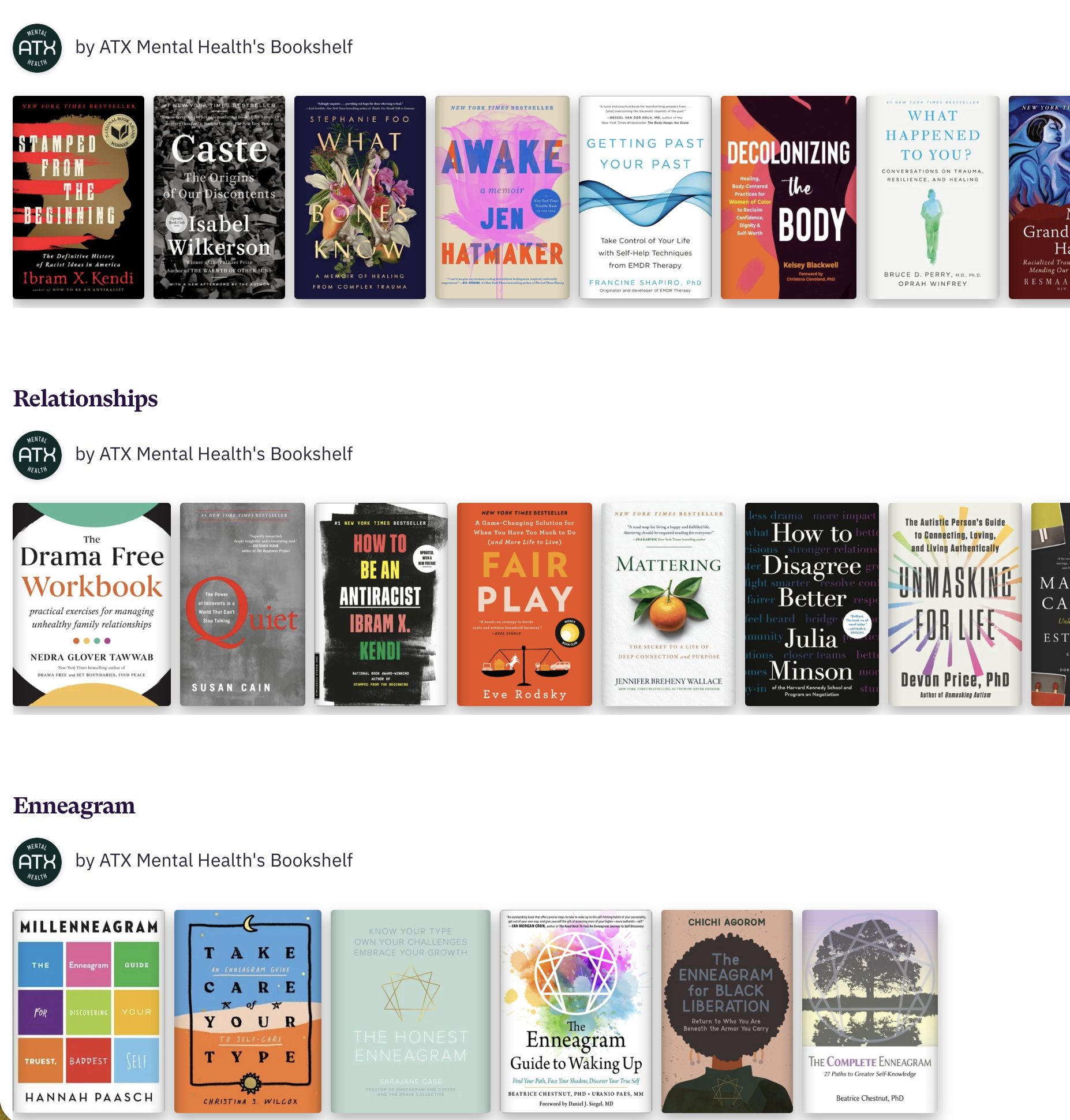
Our Bookshelf on Bookshop.org
Bookshop.org is an online bookstore built to support independent booksellers, operating as a real alternative to Amazon that puts money back into local shops. This is our curated reading list at ATX Mental Health filled with books we keep in our offices and homes. These are books we've found genuinely useful — personally and clinically — for clients doing the work, families supporting someone they love, and anyone looking for a place to start. Every purchase through our list generates income for independent bookstores, including your local one.
Podcasts We Love
Follow along on Instagram


Resources by Topic
Crisis
If you or someone you love is in crisis right now, please reach out to one of the lines below. They're staffed around the clock, they're free, and asking for help is exactly what these lines are here for.
Call or text 988 or text ‘HOME’ to 741741
-
Bluebonnet Trails 24/7 Crisis Hotline — Williamson County 1-800-841-1255 Your first call if you're in Round Rock, Hutto, Georgetown, Taylor, or anywhere in Williamson County. Connects you to mobile crisis response, short-term residential stabilization, and youth crisis services. One number reaches everything.
Williamson County Mobile Crisis Outreach Team 512-943-3545 Dispatches mental health professionals directly to where you are — home, school, a parking lot, wherever. Available 24/7.
Integral Care 24/7 Crisis Helpline — Travis County 512-472-4357 Travis County's primary mental health crisis line. Licensed counselors available around the clock for immediate assessment, crisis intervention, and referrals. Also the access point for mobile outreach and residential crisis programs.
Integral Care Psychiatric Emergency Services (PES) — Walk-in 601 E. 15th Street, Austin 78701 Walk-in mental health urgent care. No appointment needed. Monday–Friday 8am–8pm, Saturday–Sunday 10am–3pm, open holidays 10am–5pm. Hours subject to change — confirm at integralcare.org before going.
Hope Alliance — Williamson County Hotline: 1-800-460-SAFE (7233), 24/7 The only domestic violence and sexual assault shelter in Williamson County. Free crisis counseling, emergency shelter, legal advocacy, and accompaniment to hospital, police, and court. If you or someone you know is not safe at home, this is the line to call.
SAFE Alliance — Travis County SAFEline: 512-267-SAFE (7233), 24/7 | Text: 737-888-7233 Crisis support for domestic violence, sexual assault, and child abuse in the Austin area. Confidential. Available by call, text, and online chat.
Emergency Rooms — when it's life-threatening If someone is in immediate danger, call 911 or go directly to an emergency room.
Seton Medical Center Williamson — 512-324-4170 (Round Rock)
St. David's Round Rock Medical Center — 512-341-6428
Dell Children's Medical Center — 512-324-0150 (Austin — pediatric)
-
988 Suicide & Crisis Lifeline Call or text 988, 24/7 For anyone in emotional distress, suicidal crisis, or mental health emergency. Free, confidential, available in English and Spanish. Call, text, or chat at 988lifeline.org. TTY users: dial 711 then 988. Note: 988 operators may contact emergency services if they believe someone's life is at imminent risk.
Crisis Text Line Text HOME to 741741, 24/7 Text-based crisis support for any kind of crisis. If calling feels like too much, start here.
SAMHSA National Helpline 1-800-662-HELP (4357), 24/7 Free, confidential treatment referrals for mental health and substance use. English and Spanish. Doesn't provide counseling directly but can connect you to local programs, support groups, and treatment facilities. Text your zip code to 435748 to find options near you.
NAMI Helpline 1-800-950-NAMI (6264) or text HELPLINE to 62640 Monday–Friday, 10am–10pm ET Not a 24/7 crisis line, but a strong daytime option for anyone with questions about mental health conditions, treatment options, or how to support a loved one.
211 Texas Call or text 211, 24/7 Statewide navigation line. If you're not sure what you need or where to find it, start here. Trained navigators connect you to local mental health, housing, food, and financial resources.
-
National Domestic Violence Hotline 1-800-799-SAFE (7233), 24/7 | Text LOVEIS to 22522 Trained advocates available by call, text, and chat in over 170 languages. TTY: 1-800-787-3224. If you aren't sure whether what you're experiencing is abuse, they will talk it through with you without pressure.
Hope Alliance — Williamson County 1-800-460-SAFE (7233), 24/7 Local shelter and crisis services for domestic and sexual violence survivors in Williamson County. Free. (Also listed in local resources above.)
SAFE Alliance — Travis County 512-267-SAFE (7233), 24/7 | Text: 737-888-7233 Austin-area crisis support, housing, and advocacy for domestic violence, sexual assault, and child abuse survivors.
RAINN National Sexual Assault Hotline 1-800-656-HOPE (4673), 24/7 Connects you with a trained staff member from a local sexual assault service provider. Online chat in English and Spanish at rainn.org.
Love Is Respect 1-866-331-9474, 24/7 | Text LOVEIS to 22522 Focused specifically on dating abuse for teens and young adults. loveisrespect.org.
National Human Trafficking Hotline 1-888-373-7888, 24/7 | Text BEFREE to 233733 Available in more than 200 languages. Connects survivors to local services, safety planning, and confidential support.
Texas Advocacy Project texasadvocacyproject.org Free legal services for survivors of domestic violence, sexual assault, and stalking in Texas. Covers safety planning, legal representation, and help navigating the court system. Not a crisis line — but an important next step once immediate safety is established.
-
A note before this list: As of July 2025, the 988 Lifeline no longer offers the LGBTQ+-specific "Press 3" option. The resources below are staffed by people trained in LGBTQ+-affirming crisis support.
Trevor Project — for youth under 25 1-866-488-7386, 24/7 | Text START to 678-678 | Chat at chat.trvr.org Crisis intervention and suicide prevention for LGBTQ+ young people. Confidential and affirming.
Trans Lifeline 1-877-565-8860 | Monday–Friday 10am–6pm PT Peer support phone service run by trans people for trans and questioning callers. Check translifeline.org for current hours and holiday closures.
LGBT National Help Center Adults: 888-843-4564 | Youth: 800-246-7743 Monday–Friday 1–9pm PT, Saturday 9am–2pm PT Peer support, community connections, and local resources for callers of all ages. Online chat available at lgbthotline.org.
BlackLine 1-800-604-5841, 24/7 | Call or text Crisis and peer support centering Black, Indigenous, and People of Color, LGBTQ+ individuals, and those with intersecting identities.
-
Veterans Crisis Line Call 988 then press 1 | Text 838255 | Chat at veteranscrisisline.net, 24/7 Staffed by veterans and VA-trained responders. Available to all veterans even if not registered with the VA or enrolled in VA healthcare. TTY: 1-800-799-4889.
Military Sexual Trauma Safe Helpline 1-877-995-5247, 24/7 | Chat at safehelpline.org Confidential crisis support for service members who have experienced sexual assault or harassment. Available worldwide.
-
Childhelp National Child Abuse Hotline 1-800-422-4453, 24/7 | Call or text For children being abused, adults concerned about a child, and adult survivors of childhood abuse. childhelphotline.org.
National Runaway Safeline 1-800-RUNAWAY (1-800-786-2929), 24/7 Free, confidential support for runaway and homeless youth. Chat available at 1800runaway.org.
WCAC — Williamson County Children's Advocacy Center wcacrocks.org Local services for children who have experienced abuse and their non-offending family members. Not a crisis hotline — call 911 or the Childhelp line for immediate safety needs, then connect with WCAC for ongoing support.
Dell Children's Medical Center ED 512-324-0150 | Austin Pediatric emergency care for children in immediate medical or psychiatric crisis.
-
Maternal Mental Health Hotline 1-833-943-5746, 24/7 Free, confidential support for pregnant women and new mothers. English and Spanish.
National Alliance for Eating Disorders Helpline 1-866-662-1235 | Monday–Friday, 9am–7pm ET | Text ALLIANCE to 741741 Support, resources, and treatment referrals for eating disorders.
National Problem Gambling Helpline 1-800-522-4700, 24/7 | Chat at ncpgambling.org/chat Confidential support and referrals for gambling addiction.
Partnership to End Addiction Helpline 1-855-378-4373 | Monday–Friday, business hours For families of people struggling with addiction. Specialists help families navigate care and treatment options. English and Spanish.
StrongHearts Native Helpline 1-844-7NATIVE (1-844-762-8483), 24/7 Domestic and sexual violence hotline for Native Americans and Alaska Natives. Culturally appropriate support and advocacy.
Disaster Distress Helpline 1-800-985-5990 | Text TalkWithUs to 66746, 24/7 Crisis counseling for people experiencing distress related to natural or human-caused disasters.
Basic Needs
Healing is harder when basic needs aren't met. Food insecurity, housing instability, no access to medical care you trust — these aren't separate from mental health. They're part of it. The resources below are for the whole picture, not just what happens in session.
-
Not sure where to start or what you qualify for? Call or text 211 — navigators can help you find the closest option and walk you through next steps.
Hutto Resource Center — Hutto residents 512-688-0162 | huttoresourcecenter.org Food pantry open Wednesdays 2–3:30pm and 1st, 3rd, and 5th Saturdays 9am–12pm. No income requirements — anyone who needs food is eligible. Also provides financial assistance for utilities, rent, cellphones, internet, prescriptions, and medical bills for Hutto residents. Senior home delivery available for adults 65+ or those who are homebound.
Round Rock Area Serving Center — Southern Williamson County 512-244-2431 | rrasc.org Food pantry, home delivery, clothing, furniture, and financial assistance for utilities, rent, and prescriptions. Apply online first — a food voucher is required before your first pantry visit. No photo ID required.
Circle of Hope Community Center — Round Rock and surrounding areas circleofhopecc.org Food pantry serving Round Rock, Hutto, Pflugerville, Georgetown, Cedar Park, and surrounding areas. Over 2,500 families served per month.
Central Texas Food Bank — Find Food Now 512-282-2111 | centraltexasfoodbank.org/find-food Partner pantries and mobile food distributions across all of Williamson County, including Bartlett, Taylor, Jarrell, Cedar Park, Georgetown, Leander, Round Rock, Florence, and Hutto. Use the online locator or call to find the closest option.
SNAP — Supplemental Nutrition Assistance Program yourtexasbenefits.com Monthly food assistance for eligible Texas households. Apply at YourTexasBenefits.com or call 211 to be connected to an eligibility navigator who can walk you through the application.
-
Availability and eligibility for these programs change frequently. Call or text 211 before making calls — navigators have real-time information on what's currently open and what you qualify for.
findhelp.org findhelp.org Enter your zip code to search a regularly updated database of free and reduced-cost programs in your area across rent, utilities, food, transportation, childcare, and more. Browse anonymously and connect directly to organizations. The United Way for Greater Austin's ConnectATX (connectatx.org) runs on the same platform and is tailored to the Austin metro area.
Hutto Resource Center — Hutto residents 512-688-0162 | huttoresourcecenter.org Financial assistance for utilities, rent, cellphones, internet, prescriptions, and medical bills for Hutto residents. Also offers a food pantry. No income requirements.
Round Rock Area Serving Center — Southern Williamson County 512-244-2431 | rrasc.org Financial assistance for utilities, rent, transportation, and prescriptions alongside food and household goods. Apply online before your first visit.
The Caring Place — Georgetown and northern Williamson County 512-943-0700 | caringplacetx.org Assistance with rent, utilities, temporary shelter, security deposits, transportation, and medical costs. Note: serves the portion of Hutto within Georgetown ISD only. If you're in Hutto ISD, contact the Hutto Resource Center or Round Rock Area Serving Center instead.
Hill Country Community Ministries — Cedar Park and Leander 512-259-0360 | 1005 Lacy Drive, Leander Emergency financial assistance for rent, utilities, and security deposits for Cedar Park and Leander area residents. Extended hours Thursdays until 7pm.
Salvation Army Williamson County salvationarmytexas.org Rent and utility assistance plus case management for Williamson County residents. Must be referred by a partner agency — call 211 to facilitate a referral.
-
Not sure what coverage you qualify for? Call or text 211 or visit YourTexasBenefits.com to screen for Medicaid, CHIP, and other programs before your visit.
CommUnity Care — Williamson and Travis County 512-978-9015 | communitycaretx.org Federally qualified community health center providing primary care, behavioral health, dental, and pharmacy services on a sliding scale based on income. No one is turned away for inability to pay. Locations in Round Rock, Georgetown, and Pflugerville. Verify current clinic hours before your visit.
Texas Health Steps
hhs.texas.gov/texashealthsteps Free or low-cost health, dental, and vision care for children on Medicaid or CHIP in Texas. If your child is enrolled in either program, they qualify for comprehensive checkups and specialty referrals at no cost.Medicaid & CHIP
yourtexasbenefits.com Health coverage for eligible Texans including low-income adults, children, pregnant women, and people with disabilities. Apply at YourTexasBenefits.com or call 211 to screen for eligibility before applying. -
Not sure what programs you might be eligible for? Call or text 211 — navigators can screen you for state and local benefits in one call.
NeedyMeds
needymeds.org Search by medication name to find manufacturer patient assistance programs, state programs, and discount options. Includes a free drug discount card usable at most pharmacies regardless of insurance status. Free to use.GoodRx
goodrx.com Compare prescription prices at nearby pharmacies and print or share a discount coupon. Works regardless of insurance status and frequently brings costs down significantly. Free to use.BenefitsCheckUp
benefitscheckup.org Free service of the National Council on Aging. Search 2,500+ programs for medication, housing, food, and income assistance. Particularly useful for adults over 55 who may qualify for Medicare savings programs, utility assistance, and prescription help they don't know about.
Financial Support for Therapy
Cost is one of the most common reasons people put off getting support. These resources won't make therapy free, but they can make it more possible. We'd rather help you find something that works than have you go without.
-
Open Path Collective
openpathcollective.org A nonprofit network of over 40,000 vetted therapists offering sessions at $40–$70 for individuals and $40–$80 for couples and families. Available to clients who lack adequate mental health insurance coverage and have a household income below $100,000. One-time $65 lifetime membership fee. Search by specialty, location, and telehealth availability. One of the most consistently reliable reduced-cost therapy options available nationally.Integral Care — Travis County residents 512-472-4357 | integralcare.org Travis County's public mental health authority. Low-cost outpatient counseling, psychiatric care, and substance use treatment on a sliding scale. No one is turned away for inability to pay. Call the main line to ask about current availability and eligibility.
Bluebonnet Trails Community Services — Williamson County residents 1-844-309-6385 | bbtrails.org Williamson County's public mental health authority. Outpatient mental health and substance use services on a sliding scale. Call to ask about current availability and eligibility.
CommUnity Care — Travis and Williamson County 512-978-9015 | communitycaretx.org Federally qualified community health center offering behavioral health services on a sliding scale. No one is turned away for inability to pay. Locations in Round Rock, Georgetown, and Pflugerville.
-
Rise Above the Disorder (RAD)
youarerad.org/therapy A nonprofit that covers the full cost of therapy for people who can't afford it. Social workers match you with a vetted therapist and cover the cost for three to six months. Open to anyone worldwide. Apply through the online intake form — a social worker will follow up within one to fourteen days. No income verification required. One of the most practical free therapy programs available and one of the most underutilized referrals in mental health care.TWLOHA Treatment & Recovery Scholarship
twloha.com/find-help/apply Scholarship awards covering $65–$100 per session for up to three to six months of individual therapy with a licensed mental health provider. Open to US and international applicants. Application windows open periodically — check the website for current status. If the window is closed, apply anyway and you'll be notified when the next round opens.Give an Hour
giveanhour.org A national nonprofit network of licensed mental health professionals who volunteer their time to provide free therapy to those in need. Originally founded to serve military communities but now open to anyone experiencing crisis or hardship. Sessions are one hour, free, and conducted by fully licensed clinicians. Apply through the website to be matched with a provider. A legitimate option that doesn't get enough attention outside of veteran circles.The Headstrong Project — veterans and their families only getheadstrong.org Up to 30 cost-free therapy sessions for post-9/11 veterans, service members, and their families. Evidence-based trauma treatment including CPT, EMDR, and PE. Available via telehealth nationwide. Privately funded and actively expanding as of 2025.
-
Most people with insurance don't know what their mental health benefits actually are until they get a bill they weren't expecting. The time to find out is before your first session, not after. Here are the exact questions to ask — call the member services number on the back of your insurance card and work through this list.
What to ask about coverage
"Do I have mental health or behavioral health benefits?" Most plans are required to cover mental health services, but the specifics vary significantly. Confirm that outpatient therapy is covered.
"Do I need a referral or prior authorization to see a therapist?" Some plans require your primary care physician to refer you before insurance will cover therapy. Others don't. Find out before you book.
"What is my copay per therapy session?" This is the flat amount you pay each visit regardless of what the therapist charges. Can range from $0 to $60 or more depending on your plan.
"Do I have a deductible, and has it been met?" A deductible is the amount you pay out of pocket before insurance starts covering anything. If your deductible hasn't been met, you may be paying full price for sessions until it is — even if therapy is technically "covered."
"How many therapy sessions are covered per year?" Some plans cap the number of sessions at 20 or 30. Others are unlimited. Know this before you start so you can plan accordingly.
"Is telehealth covered at the same rate as in-person sessions?" Many plans cover telehealth, but some reimburse it at a lower rate. If you're planning to do therapy by video, confirm this specifically.
"Is [therapist's name or practice name] in-network with my plan?" In-network providers have negotiated rates with your insurance. Out-of-network providers can still be used but typically cost significantly more. Always confirm before your first appointment.
"What is my out-of-pocket maximum?" This is the most you'll pay in a year before insurance covers 100% of costs. Knowing this number helps you budget if you're planning ongoing care.
If you have Medicaid or CHIP yourtexasbenefits.com Both programs cover mental health services including therapy and psychiatric care. Apply at YourTexasBenefits.com or call 211 to screen for eligibility. If you're currently uninsured and unsure whether you qualify, check before assuming you don't — eligibility is broader than most people expect.
If you need help navigating your coverage NAMI Helpline: 1-800-950-NAMI (6264) | Monday–Friday 10am–10pm ET NAMI's helpline can help you understand your insurance coverage, navigate appeals if a claim is denied, and identify local low-cost options if your insurance doesn't cover what you need. Not a crisis line — a daytime information and navigation resource staffed by people who know the system.
-
Finding a therapist who shares or deeply understands your cultural background, identity, or experience isn't a preference — it's a clinical factor. The resources below include both therapy funds that cover session costs and therapist directories to help you find the right fit. Therapy funds and directories solve different problems: a fund covers the cost of sessions; a directory helps you find the right clinician. Many people need both, in that order.
FOR BLACK WOMEN & GIRLS
The Loveland Foundation Therapy Fund
thelovelandfoundation.org/therapy-fund Financial assistance for Black women and nonbinary individuals seeking therapy nationally, covering 4–12 sessions with culturally competent therapists. Applications open quarterly — join the email waitlist if closed. Review takes 4–6 weeks. Not appropriate for urgent or crisis needs.Therapy for Black Girls — Directory
therapyforblackgirls.com Clinician-vetted directory of therapy providers for Black women and girls, searchable by location and specialty. Founded by Dr. Joy Harden Bradford, PhD. Free to search.BEAM — Black Emotional and Mental Health Collective
beam.community National organization offering a therapist directory, healing circles, and community-based resources for Black communities. Particularly strong for people who want healing spaces beyond individual therapy.
FOR BLACK MEN
Therapy for Black Men — Directory
therapyforblackmen.org Directory of clinicians providing therapy specifically for Black men. Free to search.Black Men Heal
blackmenheal.org Limited and selective free mental health service opportunities for Black men. Combines therapy access with peer support and community programming. Apply directly through the website.
FOR THE ASIAN COMMUNITY
Asian Mental Health Collective — Lotus Therapy Fund
asianmhc.org/free-therapy-funds Eight free sessions of virtual or in-person therapy over three months, with therapists from AMHC's directory licensed in your state. Applications open several times a year — check the website for current status.Asian Mental Health Collective — Therapist Directory
asianmhc.org The largest Asian therapist directory in the US. Search by state, specialty, and language. Free to use.
FOR THE LATINX COMMUNITY
Latinx Therapy — Directory
latinxtherapy.com National directory of Latinx therapists and mental health professionals. Bilingual providers included. Also includes a podcast and culturally grounded mental health resources in English and Spanish. Free to search.Melanin & Mental Health — Directory
melaninandmentalhealth.com Directory connecting individuals with culturally competent clinicians for Black and Latinx/Hispanic communities. Free to search.988 Lifeline — Spanish Language Call or text 988 (choose Spanish option when prompted), 24/7 Free crisis support in Spanish around the clock. For non-crisis mental health navigation in Spanish, call 211 and request a Spanish-speaking navigator.
FOR INDIGENOUS & NATIVE COMMUNITIES
StrongHearts Native Helpline 1-844-7NATIVE (1-844-762-8483), 24/7 Free and confidential domestic and sexual violence helpline for Native Americans and Alaska Natives, offering culturally appropriate support and advocacy. (Also listed in Crisis resources.)
Indian Health Service — Behavioral Health Division
ihs.gov/behavioral-health Federal hub for American Indian and Alaska Native behavioral health programs including mental health, substance use, and suicide prevention. Starting point for understanding IHS-eligible services.One Sky Center
oneskycenter.org National resource center for Indigenous American and Alaskan Native health, education, and research. Connects communities to culturally appropriate mental health resources and providers.
FOR THE LGBTQ+ COMMUNITY
National Queer and Trans Therapists of Color Network — Directory
nqttcn.com Directory of therapists nationwide serving queer and trans people of color specifically. Free to search.Inclusive Therapists — BIPOC Therapy Fund
mentalhealthliberation.org/bipoc-therapy-fund Free therapy for Black, Indigenous, and People of Color adults (18+) living in the US. Covers up to 12 sessions with BIPOC therapists. No immigration or citizenship status required, no documentation required. Application cycles open seasonally. Operated by Mental Health Liberation, a BIPOC-led nonprofit. Explicitly serves people with multiply-marginalized identities including LGBTQ+ and neurodivergent individuals.
FOR THE MUSLIM COMMUNITY
Naseeha Mental Health Helpline
naseeha.org | 1-866-627-3342 Muslim-staffed mental health helpline providing peer support, counseling, and resource navigation. Income-based assistance available for ongoing care.
CROSS-COMMUNITY DIRECTORIES
Clinicians of Color
cliniciansofcolor.org Directory of mental health clinicians with diverse racial and ethnic backgrounds, searchable by specialty, location, and insurance. Free to use.Inclusive Therapists — General Directory
inclusivetherapists.com Directory prioritizing clinicians serving BIPOC, LGBTQ+, neurodivergent, and disabled communities. Filters for identity, specialty, language, and insurance. Free to search.
-
We work with several major insurance plans and offer self-pay rates for clients who are uninsured or prefer not to use insurance. If cost is a concern, reach out before you decide it's not possible — Kelly can walk you through your options before you commit to anything.
Contact us at info@atxmentalhealth.com or 737-331-1213.
We'd rather have an honest conversation about cost than have you go without support.
Stress & Burnout
Most conversations about burnout focus on productivity hacks and time blocking. This section isn't that. These resources are about the deeper question underneath: why you're exhausted, what you're actually owed, and how to build a life that doesn't run on empty. Burnout isn't a personal failing. It's usually a structural problem, and understanding that distinction changes how you address it.
-
Burnout is a specific clinical state — not the same as being tired, stressed, or having a hard week. It has three components that tend to show up together: emotional exhaustion, a growing sense of detachment or cynicism toward your work or life, and a reduced sense of effectiveness no matter how much effort you put in. If those three things are familiar, you're probably not just tired.
The distinction matters because rest alone won't fix burnout. Neither will a vacation. What helps is understanding the stress cycle — the difference between removing a stressor and actually completing the physiological response your body started when the stressor appeared. Most people remove stressors without ever finishing the cycle, which is why they can go on vacation and come back feeling exactly the same.
Caregiver burnout follows the same pattern with an added layer: the person you're depleting yourself for is someone you love, which makes the resentment harder to name and the guilt harder to set down. Whether you're burning out at work, at home, or in a caregiving role — or all three simultaneously — the underlying mechanism is the same.
Burnout Self-Assessment — Help Guide helpguide.org/mental-health/stress/burnout-prevention-and-recovery
Free, clinician-reviewed guide to recognizing burnout symptoms, understanding causes, and identifying whether what you're experiencing crosses the threshold from stress into burnout. Covers occupational burnout, caregiver burnout, and the physical symptoms that accompany both. One of the more clinically accurate free resources available on this topic.
The Maslach Burnout Inventory mindgarden.com/117-maslach-burnout-inventory
The gold standard clinical assessment for burnout, developed by Christina Maslach. The framework alone — emotional exhaustion, depersonalization, and reduced personal accomplishment — is useful even without taking the full validated tool. Understanding the three-component model gives you language for what you're experiencing and makes it harder to dismiss as just being tired.
-
Caregiver burnout is one of the most underacknowledged forms of exhaustion there is. It builds slowly, often invisibly, in people who are so oriented toward someone else's needs that they don't notice their own until the system breaks down. The guilt that comes with admitting you're struggling — when the person you're caring for is struggling more — is real and it makes everything harder. These resources are for people carrying that weight.
Caregiver Action Network caregiveraction.org | 855-227-3640
National nonprofit providing education, peer support, and resources for family caregivers across all illness types and life stages. Offers resources and communities for caregivers, including tips on balancing caregiving with self-care. ISEEFree to access. One of the most comprehensive caregiver-specific organizations available — covers the practical, emotional, and financial dimensions of caregiving without collapsing them into a single message about self-care.
Family Caregiver Alliance caregiver.org | 800-445-8106
National nonprofit providing information, education, and support for caregivers. Extensive factsheet library, online support group directory, and a helpline staffed by care consultants. Particularly strong on the legal and financial dimensions of caregiving alongside the emotional ones. Available in Spanish, Chinese, Vietnamese, and more.
Well Spouse Association wellspouse.org
Peer support organization specifically for spousal and partner caregivers — people whose partner has a chronic illness or disability. Includes support groups, a mentoring program, and a newsletter. One of the few organizations that acknowledges the specific relational and emotional complexity of being a caregiver to a romantic partner rather than a parent or child. The grief, loneliness, and identity loss that comes with that role are distinct and rarely named elsewhere.
Respite Locator — ARCH National Respite Network archrespite.org/respite-locator
Respite care — temporary relief from caregiving responsibilities — is one of the most consistently recommended interventions for caregiver burnout and one of the least-used because people don't know how to access it. ARCH's national locator connects caregivers to respite programs in their area. Free to use.
-
Working parent burnout is its own specific thing. It's not just occupational burnout and it's not just parenting overwhelm — it's the particular exhaustion of never fully being in either place, the invisible cognitive load of managing a household that nobody counts as work, and the persistent feeling that you're doing everything halfway. These resources address it as the structural problem it is rather than a personal failure of time management.
Fair Play — Website & Resources fairplaylife.com
The companion platform to Eve Rodsky's book Fair Play. Free resources for couples and households navigating the unequal distribution of domestic and cognitive labor. Includes a card game version of the system, a documentary on Netflix, and tools for having the conversation about who is carrying what in a relationship — without it turning into a fight. The book is in our reading list; the website is the entry point. Particularly useful for dual-income households where the invisible load has never been named explicitly.
Bright Horizons — Work-Life Thought Leadership brighthorizons.com/resources
One of the most substantive free resources on working parent stress, flexibility, and sustainable productivity. Covers childcare, eldercare, and the intersecting demands that working parents navigate. Less clinical than most resources in this space and more practically oriented — useful for people trying to understand the structural dimensions of their exhaustion rather than just individual coping strategies.
Motherly — Burnout Resources mother.ly/life/burnout
Motherly's burnout resource library addresses maternal burnout, depleted mother syndrome, and the specific experience of women navigating caregiving, career, and identity simultaneously. Well-researched and written for a lay audience. Particularly useful for mothers who feel like their exhaustion is somehow their fault for not managing it better.
Spirituality & Faith
Spirituality means something different to everyone. It doesn't require religion, and it doesn't require certainty. Whether you're grounded in a tradition, in the middle of questioning one, rebuilding after spiritual harm, or simply trying to locate meaning in a season that's made that hard, these resources don't ask you to land anywhere in particular. They meet you where you are.
-
Spirituality doesn't require a tradition, a label, or certainty about anything. For some people it's a lifelong practice. For others it's something they're coming back to after a long absence, or encountering for the first time after a loss that made ordinary explanations feel inadequate. These resources don't ask you to land anywhere in particular — they're for the process of looking.
On Being with Krista Tippett onbeing.org One of the longest-running and most respected platforms on spirituality, meaning, and the human experience. Includes a podcast, essays, and poetry. Genuinely interfaith and secular-friendly — guests range from theologians to scientists to poets. Useful for people exploring what they believe rather than seeking to confirm an existing framework. The podcast archives alone are a significant resource.
The Work of the People theworkofthepeople.com Short documentary films on faith, meaning, spiritual formation, and the interior life. Produced for a broadly Christian audience but consistently thoughtful and accessible beyond that tradition. Particularly useful for people who are still within a faith community but feeling spiritually restless or dry.
Sounds True soundstrue.com Publisher and content platform covering contemplative practice, mindfulness, psychology, and spirituality across traditions — Buddhist, Christian, Jewish, Indigenous, and secular. Free podcast and articles alongside paid courses. One of the most substantive interfaith learning platforms available.
-
Deconstruction is the process of examining beliefs you inherited or adopted and deciding what, if anything, you want to carry forward. It's often disorienting, sometimes isolating, and frequently harder than people expect — especially when the community and the theology are woven together. These resources are for people somewhere in that process.
The Liturgists theliturgists.com Podcast and community for people in the deconstruction process. Non-prescriptive, genuinely inclusive, and honest about doubt. One of the most widely listened-to communities in this space — useful for people who feel homeless between the tradition they left and a secular world that doesn't quite fit either.
Reclamation Collective reclamationcollective.com Community and resource hub for people healing from spiritual abuse and religious trauma. Offers support groups, a therapist directory of practitioners with religious trauma experience, and education for clinicians. Particularly strong for LGBTQ+ individuals navigating harm within faith communities.
Religious Trauma Institute religioustraumaresearch.com Education, research, and resources on religious trauma — the specific psychological harm that can result from high-control religious environments. Includes a clinician directory of therapists trained in religious trauma. Useful for people trying to understand what happened to them and for those supporting someone in that process.
Reclaiming My Theology — Podcast reclaimingmytheology.com Hosted by Brenda Marie Davies. Honest conversations about faith, doubt, deconstruction, and reconstruction from a perspective that takes belief seriously without requiring you to stay where you are. Particularly good for people who still feel drawn to spirituality but can't return to the tradition they left.
-
Spiritual abuse is real, it causes real harm, and it doesn't always look like what people expect. It can happen in any tradition and at any level of a religious community. The harm is often compounded by the fact that the people who caused it may still be part of your family, your community, or your understanding of who God is. These resources are for people trying to name what happened and figure out what healing looks like.
Religious Trauma Institute religioustraumaresearch.com The most clinically grounded resource available on religious trauma. Includes education, research, a therapist directory, and resources for survivors trying to understand their experience. A good first stop for anyone who has started wondering whether what they experienced had a name.
Reclamation Collective reclamationcollective.com Peer community, support groups, and therapist directory for people healing from spiritual abuse. (Also listed in Accordion 2 — appears in both because it serves both audiences.)
Spiritual Abuse Resources — freehealthy.com freehealthy.com/spiritual-abuse Curated library of articles, research, and survivor accounts related to spiritual abuse across traditions. Useful for people who want to understand the dynamics of what happened before they're ready to talk to someone about it.
SNAP — Survivors Network of those Abused by Priests snapnetwork.org The largest and oldest support group for survivors of sexual abuse by religious authority figures. Chapters and online support groups available nationally. Originally founded to serve Catholic survivors, the network now serves people from many traditions.
Neurodivergence
Neurodivergence is central to who we are as a practice. Whether you're newly diagnosed, supporting a child through an evaluation, or finally getting language for something you've experienced your whole life, these are the resources we point clients and families toward most often.
-
Neurodivergence is central to who we are as a practice. Whether you're newly diagnosed, supporting a child through an evaluation, finally getting language for something you've lived with your whole life, or questioning whether a label even fits — you're in the right place.
The umbrella is broad. ADHD, autism, dyslexia, sensory processing differences, giftedness, twice-exceptionality, and the overlaps between them all fall within what we mean when we talk about neurodivergence. These aren't deficits. They're different ways of processing, sensing, relating, and navigating a world that wasn't designed with your brain in mind.
Understood understood.org The most comprehensive free resource available for adults and parents navigating learning and thinking differences — ADHD, dyslexia, dysgraphia, dyscalculia, and more. Well-written, non-clinical, and genuinely useful at every stage from first suspicion through established diagnosis. Includes a therapist and specialist directory, community forums, and a podcast. The single best starting point for most people landing on this page.
Neurodivergent Insights — Dr. Megan Neff neurodivergentinsights.com Research-informed resources, infographics, and clinical guidance for autistic and ADHD adults created by a neurodivergent clinician with lived experience. Particularly strong on AuDHD — the co-occurrence of autism and ADHD — late diagnosis, and the intersection of neurodivergence with mental health. One of the most substantive free content hubs in this space.
Autism Society of Central Texas autismsociety-tx.org Local chapter providing resources, advocacy, and community for autistic individuals and families in the Austin area. Worth connecting with for families navigating school systems, evaluations, and services in Williamson and Travis counties.
-
CHADD — Children and Adults with ADHD chadd.org | 800-233-4050 The national gold standard for ADHD education, advocacy, and support. Includes a local chapter directory, clinician finder, and online community. Excellent for both newly diagnosed adults and parents navigating a child's diagnosis. The website's resource library is one of the most clinically reliable free sources of ADHD information available.
ADDA — Attention Deficit Disorder Association add.org Adult-focused ADHD resources, peer support groups, and advocacy. Where CHADD skews toward parents and families, ADDA is built specifically for adults with ADHD. Includes a virtual support group directory — useful for adults who want peer community without a clinical setting.
ADDitude Magazine additudemag.com Extensive library of articles, expert Q&As, webinars, and practical guides for adults and parents navigating ADHD. One of the most accessible and well-researched consumer ADHD publications available. Free to browse; newsletter worth subscribing to.
How to ADHD — YouTube youtube.com/@HowtoADHD Hosted by Jessica McCabe, this channel translates ADHD research into practical, accessible video content. One of the most widely recommended free resources for newly diagnosed adults and teens. Short episodes, evidence-based, and made by someone with lived experience.
Focusmate focusmate.com Virtual body-doubling platform that pairs you with an accountability partner for 25, 50, or 75-minute work sessions. One of the most consistently effective free tools available for ADHD task initiation. Three free sessions per week.
-
NeuroClastic neuroclastic.com Community-generated resource hub written by and for autistic people. Covers late diagnosis, masking, autistic burnout, relationships, and employment — from an autistic perspective rather than a clinical one. One of the most honest and peer-informed resources available.
Embrace Autism embrace-autism.com Supportive resource hub for individuals, families, and clinicians seeking to understand and affirm autistic identity. Includes several validated self-assessment tools including the RAADS-R for adults exploring whether autism fits their experience.
International Dyslexia Association dyslexiaida.org The national gold standard for dyslexia education, research, and advocacy. Updated their official definition of dyslexia in 2025. Free resources include a family handbook, fact sheets, and a provider directory. Texas branches serve the Austin and Houston areas.
Decoding Dyslexia Texas decodingdyslexiatx.org Texas-based parent-led advocacy organization working to improve educational policies and resources for students with dyslexia across the state. Useful for families navigating the Texas public school system specifically — IEPs, dyslexia program requirements, and advocacy strategies.
STAR Institute for Sensory Processing sensoryhealth.org The leading clinical and research center for sensory processing disorder. Includes a provider directory for finding occupational therapists and clinicians trained in sensory processing, free educational resources, and a screening tool. The most authoritative resource available on this topic.
-
Understood — For Teens understood.org/en/for-teens Understood's teen-specific section is written directly for young people navigating learning and thinking differences. Covers school, friendships, self-advocacy, and what it actually means to have ADHD, dyslexia, or other differences. A rare resource that doesn't talk down to its audience.
Supporting Emotional Needs of the Gifted (SENG) sengifted.org National organization focused on the social, emotional, and mental health needs of gifted and twice-exceptional individuals. Includes a parent group directory, webinars, and a provider list. Particularly useful for families whose gifted child is also struggling in ways that don't match the "high achiever" expectation.
Full Tilt Parenting — Podcast fulltiltparenting.com Hosted by Debbie Reber. Podcast and resource hub for parents of neurodivergent kids covering ADHD, autism, dyslexia, PDA, giftedness, and twice-exceptionality. Practical, strengths-based, and honest about how hard this parenting experience can be.
Child Mind Institute childmind.org Extensive, clinician-developed library on children's mental health, behavior, learning, and development. Our go-to recommendation for parents trying to understand what's going on with their child before or between sessions. (Also listed in Parenting & Family Support.)
Sex & Pleasure
Sexual wellbeing is part of overall health, and it rarely gets the space it deserves. Whether you're navigating desire changes, healing from shame or purity culture, recovering from religious harm around sexuality, or just trying to understand your own body better, these resources treat the topic with the seriousness and warmth it deserves. There's no version of whole-person care that leaves this out. Resources in this section are intended for adults 18 and over.
-
Most of us didn't get accurate, complete sex education growing up. What we got was either clinical and disconnected from actual experience, rooted in shame, or simply absent. These resources are for adults filling in those gaps.
Emily Nagoski — The Dirty Normal emilynagoski.com | thedirtynormal.com
The dual control model — arousal has both an accelerator and a brake — is the single most useful reframe available for understanding your own sexual response. Nagoski's website and newsletter are free. Her books are in our reading list. Start here before anything else in this section.
Planned Parenthood — Learn plannedparenthood.org/learn
Free, clinician-reviewed sexual health education covering anatomy, contraception, STIs, relationships, and consent. One of the most accurate and comprehensive free libraries available for adults filling in gaps from abstinence-only education.
A note on Planned Parenthood: we recognize this organization is politically controversial in Texas and beyond. We list it here because the educational content is clinically accurate, free, and written for adults — and because accurate sexual health information shouldn't be contingent on political agreement. The Learn section is an educational library only and is not affiliated with any clinical services.
The Pleasure Mechanics — Written & Audio Resources pleasuremechanics.com
Free guides and audio practices on pleasure, anatomy, communication, and intimacy from certified sexologists. Accessible and non-clinical. A good complement to Nagoski's more science-forward writing.
Come As You Are — The Podcast Available on all major podcast platforms
Emily Nagoski's eight-episode audio series on desire, arousal, and the science behind her work. Closer to a short audio course than a general podcast. Covers the dual control model, arousal nonconcordance, context and desire. Free to listen.
Sex, Explained Available on Netflix
Short-form documentary series covering desire, fertility, attraction, and the science of sex. Accessible, well-produced, and a good starting point for anyone who learns better through visual content than reading.
-
Purity culture's effects don't disappear when the beliefs do. Shame, fear, disconnection from the body, and difficulty accessing desire or pleasure can persist long after someone has intellectually rejected the framework they were raised in. That's not a personal failure. It's how nervous system learning works.
Celeste Holbrook, PhD celesteholbrook.com
Texas-based sexologist and author of Missionary Position — one of the most specific and compassionate voices working at the intersection of religious upbringing, sexual shame, and embodied healing. Her work is particularly resonant for clients navigating faith and sexuality simultaneously, which is a significant portion of the Central Texas population. Worth knowing as both a resource and a potential referral for clients who need someone who has thought deeply about this territory. Her book is in our reading list.
Reclamation Collective reclamationcollective.com
Community and resource hub for people healing from spiritual abuse and religious trauma, including the sexual shame that often accompanies it. Includes support groups and a therapist directory with religious trauma experience. Particularly strong for LGBTQ+ individuals navigating the intersection of faith community harm and sexuality. (Also listed in Spirituality & Faith.)
The Body Is Not an Apology thebodyisnotanapology.com
Sonya Renee Taylor's platform on radical self-love addresses the body and sexuality as inseparable from identity and dignity — including for people whose bodies have been the site of shame, religious erasure, or cultural judgment about what they're allowed to want. Free articles and community access.
Religious Trauma Institute religioustraumaresearch.com
Education and resources on the psychological harm caused by high-control religious environments — including how purity culture messaging becomes embedded in the nervous system. Includes a therapist directory. (Also listed in Spirituality & Faith.)
The Principles of Pleasure Available on Netflix
Documentary series examining female pleasure through science, history, and personal experience. Addresses the cultural and historical forces that have shaped women's relationship with their own sexuality — a direct companion to purity culture recovery work. Research-informed and non-explicit.
Foreplay Radio — Couples and Sex Therapy Available on all major podcast platforms
Hosted by licensed sex therapist Dr. Laurie Watson and couples therapist George Faller, LMFT. Referenced here specifically for episodes addressing sexual shame, purity culture recovery, and how religious background shapes sexual functioning — a thread that runs through much of their catalog.
-
Desire discrepancy — when partners want sex at different frequencies or in different ways — is one of the most common reasons couples come to therapy, and one of the most misunderstood. These resources address what's actually happening underneath, why the question is rarely about wanting more, and what it takes to build a satisfying sexual connection over time.
Esther Perel estherperel.com
One of the most original thinkers on desire and long-term connection. Her central argument — that desire requires distance, mystery, and aliveness, and that the safety of committed partnership can work against those things — reframes desire discrepancy in a way that removes blame from both partners. Free articles, podcast access, and tools on the website.
The Gottman Institute — Intimacy Resources gottman.com/couples
Free research-backed articles on sexual intimacy, desire, and the relationship between emotional safety and sexual connection. Referenced here specifically for the intimacy content — the broader Gottman couples resources live in the Couples & Relationship Support section.
Celeste Holbrook, PhD — Couples Work celesteholbrook.com
Holbrook's work extends beyond individual purity culture recovery into couples sexuality and desire — particularly for couples where religious background has shaped one or both partners' relationship with sex in ways that are now affecting the relationship. Referenced here in a distinct capacity from her listing in Healing from Shame — that section is about individual recovery; this is about what that recovery looks like inside a partnership.
AASECT Referral Directory aasect.org/referral-directory
The national credentialing body for certified sex therapists. Use the directory to find an AASECT-certified specialist in Texas, including telehealth options. If your concerns go beyond what a generalist therapist typically addresses — sexual pain, desire discrepancy, sexual trauma, compulsive sexual behavior — this is the right starting point for finding someone with specialized training.
Where Should We Begin? — Esther Perel Available on all major podcast platforms
Real couples therapy sessions with Perel as the therapist, lightly edited for audio. Hearing real couples navigate desire and disconnection normalizes the struggle and gives language to dynamics that are hard to name from the inside. Referenced here for the intimacy and desire episodes specifically — her broader relationship content lives in Couples & Relationship Support.
Speaking of Sex — The Pleasure Mechanics Available on all major podcast platforms
Practical, non-judgmental conversations on pleasure, intimacy, and sexual wellbeing hosted by certified sexologists. Referenced here in a distinct capacity from the written resources listed in Education & Body Literacy — the podcast covers relational and partnered sexuality more directly than the written guides.
-
Sexual personhood doesn't require a partner, an active sex life, or anyone's permission to exist. It is part of who you are — not a function of your relationship status, not something that switches off between relationships, not something you have to earn or perform or justify. These resources affirm that.
The Body Is Not an Apology thebodyisnotanapology.com
Referenced here in a distinct capacity from its listing in Healing from Shame. There it addresses healing from what was imposed — shame, religious erasure, cultural judgment. Here the focus is different: self-ownership as an ongoing practice, and the claim that your relationship with your own body and desire is primary, not derivative of a partner's presence or approval. Free articles and community access.
Ferly ferly.com
Audio-guided mindfulness and body awareness practices designed to help people develop a relationship with their own sexuality independent of partnership or performance. Built by sex therapists and psychologists. The emphasis is on presence, sensation, and self-knowledge rather than activity or outcome. One of the few tools built specifically for this section's purpose rather than generally applicable to other sections. Available on iOS and Android.
Emily Nagoski — Responsive Desire emilynagoski.com
One specific concept from Nagoski's work belongs here more than in Education & Body Literacy: responsive desire — the understanding that desire can emerge in response to context rather than arising spontaneously, and that this is a normal variation rather than a dysfunction or absence. This matters especially for people whose desire has been conditional on a partner or external prompt and who haven't recognized their desire as real because it doesn't arise unprompted. This is a narrower entry point into her work than what appears in Accordion 1.
Sex with Emily sexwithemily.com
Covers solo sexuality, asexuality, and sexual identity as standalone topics independent of relationship context. A broadly accessible starting point for clients beginning to claim their sexual personhood on their own terms. Podcast and free website content available. Listed here rather than in other sections because the solo and identity-focused content is what's most relevant — not the broader relationship and communication content that appears in much of the catalog.
Chronic Illness
Living with a chronic illness means carrying something most people around you can't see and don't fully understand. The medical system often addresses the body without touching what the body being sick actually does to a person — to their sense of self, their relationships, their ability to trust that things will be okay. These resources are for people navigating the emotional weight of long-term health conditions, not just the management of symptoms.
-
Living with a chronic illness means carrying something most people around you can't see and don't fully understand. The medical system often addresses the body without touching what the body being sick actually does to a person — to their sense of self, their relationships, their ability to trust that things will be okay. These resources are for people navigating that weight, not just the management of symptoms.
Chronic illness brings a specific kind of grief that rarely gets named — not the grief of losing someone, but the grief of losing a version of yourself, a future you assumed, an ease in your body you took for granted. The losses are real even when no one around you can see them. They deserve the same attention as any other loss.
But You Don't Look Sick — Christine Miserandino butyoudontlooksick.com
The original home of Spoon Theory — the framework that gave the chronic illness community a language for limited energy and invisible limitation. Spoons represent finite units of energy available to someone with a chronic illness. Every task costs a spoon — getting dressed, making breakfast, a phone call — and once they're gone for the day, they're gone. You can't borrow spoons from tomorrow without consequences. Thechronicillnesstherapist The site is written by and for people with chronic illness and is one of the most widely read resources in this community. The Spoon Theory essay alone is worth reading for anyone who has ever struggled to explain their experience to someone healthy — and for anyone who loves someone with chronic illness and wants to understand.
What's Your Grief whatsyourgrief.com
Free grief education platform run by two grief therapists. Includes content specifically on the grief of chronic illness — the losses that don't come with funerals, the identities that change when the body changes, the grief of what could have been. Practical, non-clinical, and genuinely useful for people who haven't had language for what they're carrying. (Also listed in Grief & Bereavement.)
The Center for Chronic Illness thecenterforchronicillness.org
National nonprofit providing free, professionally facilitated virtual support groups for anyone impacted by ongoing health challenges. All programs are free and meet virtually. Support groups are led by licensed mental health professionals who offer guidance and structure. Mayo Clinic One of the few organizations specifically built around the psychological and relational dimensions of chronic illness rather than the medical management of it.
-
The Center for Chronic Illness — Support Groups thecenterforchronicillness.org
Free, professionally facilitated virtual support groups meeting regularly online — open to anyone impacted by chronic illness or rare disease. No geographic limitation, no cost. A consistent landing place for people whose local community doesn't include anyone who gets it. (Also listed in Accordion 1.)
Health Union — Online Patient Communities healthunion.com
Network of condition-specific online communities where people with chronic illness connect, share experience, and find practical information from others who have actually been there. Covers dozens of conditions including lupus, MS, RA, migraine, COPD, and more. Not clinical — peer community. Sometimes what you need is not a professional but a person who has navigated the same situation and survived it.
NORD — National Organization for Rare Disorders rarediseases.org
If you or someone you love has a condition that is rare, undiagnosed, or poorly understood by generalist providers, NORD is the starting point. Includes a disease database, patient advocacy resources, and connections to condition-specific organizations. Useful even when a condition isn't technically rare — when the medical system doesn't have good answers, NORD's model of patient-centered advocacy applies broadly.
-
Chronic illness doesn't just affect your body. It reshapes your identity, your relationships, your sense of the future, and your understanding of what you can trust. The psychological impact of long-term illness is underserved by most of medicine and underacknowledged by most of the people in a sick person's life. These resources take that impact seriously.
The Chronic Illness Therapist — Destiny Davis, LPC thechronicillnesstherapist.com
Platform and podcast run by a licensed therapist specializing in chronic pain and invisible illness. Addresses medical gaslighting, grief, identity, and the mental health dimensions of illness that the healthcare system routinely misses. Clinically grounded, peer-voiced, and direct. Particularly useful for people who feel dismissed by their medical providers and need language for what that experience does to a person.
Refuge in Grief — Megan Devine refugeingrief.com
Megan Devine's platform for grief in all its forms — including the grief of chronic illness, the loss of the self you used to be, and the losses that don't have a name. Free articles, writing prompts, and a community alongside courses. Her framework — that grief is not a problem to be solved but an experience to be witnessed — is directly applicable to the specific grief that chronic illness produces. (Also listed in Grief & Bereavement.)
Patient Advocate Foundation patientadvocate.org | 800-532-5274
National nonprofit providing case management and financial assistance for people navigating complex illness, insurance denials, and treatment access barriers. Free. The practical and financial consequences of chronic illness are inseparable from its psychological ones — this organization addresses both by removing logistical barriers that compound emotional ones.
-
One of the most documented and underaddressed experiences of chronic illness — particularly for women, people of color, and people with invisible conditions — is being disbelieved, dismissed, or undertreated by the medical system. These resources help people navigate that system more effectively and find support when it fails them.
Patient Advocate Foundationpatientadvocate.org | 800-532-5274
Case management and financial assistance for people navigating complex illness, insurance denials, and treatment access barriers. Free. (Also listed in Accordion 3 — worth naming in both places because healthcare navigation and psychological wellbeing are inseparable in chronic illness.)
Triage Cancertriagecancer.org
For people navigating a serious illness diagnosis alongside legal and financial questions — insurance rights, employment protections, disability benefits, and more. Written by attorneys specializing in serious illness but applicable to many chronic conditions. Free resources, webinars, and a helpline. One of the most practically useful organizations for people whose illness has employment or financial consequences.
NORD — Rare Disease Patient Advocacyrarediseases.org
Includes tools for connecting with disease-specific advocacy organizations, navigating specialty care, and accessing clinical trials. Useful for people whose condition is rare or whose providers have limited experience with it.
Parenting
Parenting is the most demanding work most people will ever do, and one of the least supported. These resources are for parents who want to understand what's actually happening inside their kids, work through their own patterns before they pass them on, and feel less alone in the daily weight of it. The work you do on yourself is part of the work you do for them.
-
Parenting is the most demanding work most people will ever do, and one of the least supported. These resources are for parents who want to understand what's actually happening inside their kids — not just how to manage behavior, but what drives it. The work you do on yourself is part of the work you do for them.
Good Inside — Dr. Becky Kennedy goodinside.com | @drbeckyatgoodinside on Instagram
The most widely recommended parenting resource in clinical practice right now and for good reason. Dr. Becky Kennedy's platform is rooted in attachment theory, IFS, and developmental psychology — and translates all of it into practical, plain-language guidance for real parenting moments. The website includes articles, videos, and a membership community. The Instagram account functions as a quick-access library of scripts for specific situations — tantrums, sibling conflict, school refusal, bedtime — that you can read in two minutes and try that night. Free to browse; paid membership available.
Child Mind Institute childmind.org
The leading independent nonprofit in children's mental health. Extensive, clinician-developed library covering behavior, learning, anxiety, ADHD, autism, depression, and more — searchable by age, symptom, and condition. Our go-to recommendation for parents trying to understand what's going on with their child before or between sessions. Written for parents, not clinicians. Free to access.
Zero to Three zerotothree.org
Research-based resources specifically for parents of children from birth through age five. Covers brain development, temperament, sleep, social-emotional learning, and everyday caregiving. Particularly useful for new parents trying to distinguish what's developmentally typical from what warrants attention. One of the more clinically grounded free resources for early childhood.
Good Inside with Dr. Becky Kennedy — Podcast Available on all major podcast platforms
Short, specific episodes on scenarios parents actually face — connection before correction, holding limits without punishing, understanding big emotions. One of the most practically useful parenting podcasts available. A natural complement to the website and Instagram.
Securely Attached — Dr. Sarah Bren Available on all major podcast platforms
Hosted by a licensed clinical psychologist and mother of two. Covers brain science, attachment, and the developmental framework behind parenting decisions in accessible language. Thursday episodes feature a Q&A segment with two additional clinical psychologists answering real parent questions. One of the more rigorously grounded parenting podcasts available — useful for parents who want the clinical reasoning behind the advice, not just the advice itself.
-
Most parents know something is off before they have a name for it. These resources help you identify what you're seeing, understand what it might mean, and figure out what kind of support actually fits.
Child Mind Institute — Symptom Checker childmind.org/symptom-checker
The Child Mind Institute's symptom checker allows parents to describe what they're observing and receive clinician-informed guidance on what it might indicate and what to do next. Not a diagnostic tool — a navigation tool. A practical first step for parents who are trying to figure out whether what they're seeing warrants professional attention. Free.
NAMI — For Parents and Caregivers nami.org/Support-Education/Guides-and-Books/Children-and-Teens
NAMI's resources for parents include guidance on recognizing mental health conditions in children and teens, how to talk to a child about their mental health, how to navigate the school system, and how to access support. The NAMI Helpline (1-800-950-6264, Monday–Friday 10am–10pm ET) can also help parents figure out next steps when they're not sure what kind of help their child needs.
Texas Parent to Parent txp2p.org
Peer support and resources for families of children with disabilities and special health care needs. Run by parents for parents — the kind of support that only comes from someone who has actually navigated the same system. Free to access. Also a resource for understanding your rights as a parent of a child with a disability in Texas and navigating the school system.
Understood understood.org
Comprehensive, accessible resource for parents navigating learning and thinking differences in their children — ADHD, dyslexia, and more. Particularly useful when a child is struggling in school and a parent isn't sure whether it's a learning difference, a behavioral issue, or something else. Well-written, non-clinical, and genuinely useful. (Also listed in Neurodivergence & ADHD.)
Unruffled with Janet Lansbury Available on all major podcast platforms
Q&A format podcast where parents submit real situations and Lansbury responds. Rooted in RIE philosophy — a respectful, calm approach to parenting. Excellent for parents of toddlers and young children navigating big emotions, power struggles, and behavior that feels unmanageable. No expert guests, no filler — just direct responses to real parenting situations.
-
Children grieve differently than adults — often in shorter bursts, through play, and without the language to name what they're experiencing. These resources help parents and caregivers understand what childhood grief actually looks like and how to support a child through it without getting in the way.
The Dougy Center dougy.org
The first center in the United States to provide peer support groups for grieving children and the most clinically credible resource available on this topic. Free resources, training, and guides for parents, teachers, and clinicians — including downloadable guides on how to talk to children about death at different developmental stages, how to recognize grief in children, and when to seek additional support. Also includes a searchable directory of peer grief support programs for children and teens nationwide. (Also listed in Grief & Bereavement.)
Hospice Austin — Camp Brave Heart hospiceaustin.org
Free summer camp for children and teens grieving the loss of someone important in their life. Offered annually through Hospice Austin's bereavement program. Open to the community — no prior Hospice Austin connection required. One of the few free grief-specific programs for children in Central Texas. (Also listed in Grief & Bereavement.)
National Alliance for Grieving Children childrengrieve.org
Directory of grief support providers specifically for children and teens, searchable by location. Also includes resources for parents and caregivers on how to recognize and support grief in young people. Free to use.
Grief Out Loud — The Dougy Center Available on all major podcast platforms
Hosted by the Dougy Center. Covers personal stories, tips for supporting grieving children and teens, and interviews with professionals. The most focused and clinically credible podcast for parents and caregivers supporting a child through loss.
Couples
Relationships are worth investing in before they're in crisis. The resources here are for couples and individuals who want to understand the patterns they're in, communicate more honestly, and build something more sustainable together. Not just repair what's broken.
-
Couples therapy and relationship resources aren't only for married heterosexual couples in crisis. They're for partners at any stage — newly together, long-term, cohabiting, long-distance, polyamorous, same-sex, or navigating a transition. They're for people who want to strengthen something good, people who are in real trouble, and people who aren't sure yet which category they're in.
Whatever your relationship structure, sexual orientation, or stage, these resources were built with you in mind — and so was the work we do at ATX Mental Health.
The Gottman Institutegottman.com/couples
Forty years of research on what makes relationships work, available free. Includes specific research and resources for same-sex couples and LGBTQ+ relationships alongside its broader body of work. Free articles, quizzes, and tools. The Marriage Minute newsletter delivers twice-weekly relationship content to your inbox at no cost. This is the framework most ATXMH clinicians draw from in couples work.
Esther Perelestherperel.com
One of the most original thinkers on desire, intimacy, and long-term connection across relationship structures and orientations. Particularly useful for any couple navigating the tension between security and aliveness — the question of how to keep choosing each other when life has made things familiar and heavy. Free articles, podcast access, and tools on the website.
Multiamory — Podcast & Resourcesmultiamory.com
Podcast and resource hub for people in or exploring non-monogamous, polyamorous, or ethically non-exclusive relationships. Covers communication, jealousy, boundary-setting, and relationship structures without hierarchy between configurations. One of the most substantive resources available for people navigating relationships that most couples therapy frameworks weren't designed for. Free podcast; paid courses available.
A note on Multiamory: we include this resource because relationships come in many configurations and everyone deserves access to quality information regardless of their relationship structure. Listing it is not an endorsement of any particular relationship model — it's a recognition that people navigating non-traditional structures deserve the same quality of support as anyone else.
HelpGuide — Relationshipshelpguide.org/relationships
Free, clinician-reviewed articles covering relationship dynamics across structures and orientations. A solid general-purpose starting point for anyone wanting evidence-informed guidance on specific relationship concerns without committing to a full program or resource library.
-
A couple married for thirty years is navigating fundamentally different terrain than two people six months into something they're trying to build intentionally. These resources are organized by stage — not because earlier stages matter less, but because the questions are different.
NEW RELATIONSHIPS, DATING & EARLY COMMITMENT
Dr. Alexandra Solomon — Loving Bravely dralexandrasolomon.com
Clinical psychologist at Northwestern whose work focuses on relational self-awareness — understanding who you are, what you bring, and what you need in a relationship before and during early commitment. Her podcast Reimagining Love and her book Loving Bravely are both entry points. Particularly useful for people who notice the same patterns repeating across different relationships.
Relationship Hero relationshiphero.com
On-demand relationship coaching from trained coaches available by text or video. Useful for people in earlier stages who want real-time guidance on specific situations — navigating a new dynamic, understanding patterns before they solidify, or figuring out whether a relationship has what it needs to go further. Pay-per-session, no subscription required. Not therapy — practical coaching for specific situations.
Multiamory multiamory.com
Referenced here specifically for its strength in the earlier stages of building a relationship deliberately rather than by default. Covers communication frameworks and intentional structure-building for any relationship configuration. (Also listed in Accordion 1 — that entry covers the broader resource library; this entry is specifically for early-stage relationship building.)
LONG-TERM & DECADES-LONG RELATIONSHIPS
OurRelationship ourrelationship.com
An online self-guided program for committed couples built on fifteen years of federally funded research. Eight to ten hours of tailored content and activities designed to help couples improve communication, rebuild intimacy, and address recurring problems. Optional coaching add-on with weekly calls. Active duty and military families can access it free through Military OneSource. $99 without a coach, $249 with. One of the few online relationship programs backed by genuine research.
Hold Me Tight Online holdmetightonline.com
Eight-session online couples workshop based on Emotionally Focused Therapy and Sue Johnson's Hold Me Tight program. Clinically structured, evidence-based, and self-paced. Particularly well-suited for long-term couples navigating emotional distance that has built up over years — the pursue-withdraw cycle hardens over time and this program addresses it directly.
Fair Play — Website & Resources fairplaylife.com
For long-term partners and married couples navigating the unequal distribution of domestic and cognitive labor — the invisible load that accumulates over years and quietly erodes connection. Includes tools for having the conversation about who is carrying what. The book is in our reading list.
A note on Fair Play: Eve Rodsky's work has been characterized in some circles as politically motivated. We include it because the invisible cognitive and domestic load is a real and measurable stressor in long-term relationships, and because the research behind it is legitimate regardless of how it's been framed in public debate. The framework is practical, not political.
The Art and Science of Love — Workshop gottman.com/couples/art-science-of-love-workshop
Two-day intensive workshop available in-person and online, showing outcomes comparable to six months of couples therapy. Open to any committed couple. Worth knowing about as an option for couples who want a significant investment of focused time rather than ongoing weekly sessions.
ALL STAGES
The Gottman Relationship Adviser gottman.com/couples/relationship-adviser
Paid self-guided digital program based on the Gottman Assessment — a validated measure of relationship health. Couples complete it together and receive a tailored step-by-step program. Works at any relationship stage as an honest picture of where things actually are and what to do about it.
-
Most relationship conflict isn't about what it appears to be about. Underneath the argument about money, housework, or parenting is usually something older and more tender — a fear of not mattering, a pattern learned long before this relationship, an unmet need that hasn't been named clearly enough to be heard. These resources help couples understand what's actually driving conflict and build skills to navigate it differently.
The Gottman Institute — Four Horsemen gottman.com/couples
Referenced here specifically for the Four Horsemen framework — criticism, contempt, defensiveness, and stonewalling — and their antidotes. This is the most practically useful piece of free relationship research available. Most couples recognize themselves in it immediately. The Gottman website also covers the distinction between perpetual and solvable problems, which is equally important for couples in gridlock. (The broader Gottman resource library is listed in Accordion 1.)
HelpGuide — Conflict & Communication helpguide.org/relationships
Referenced here specifically for the conflict resolution and communication content — articles on fighting fair, de-escalation, and rebuilding after rupture. A practical companion to the Gottman research for couples who want accessible guidance without a structured program. (The general HelpGuide relationships library is listed in Accordion 1.)
Terry Real — Relational Life Institute terryreal.com
Terry Real's work on adaptive child patterns — the ways people learned to protect themselves early in life and how those protections become weapons in adult partnerships — is among the most clinically useful free content available on entrenched conflict. Free articles and podcast content on the website. Particularly useful when one or both partners notices their reaction to conflict is bigger than the current situation warrants.
The Gottman Relationship Adviser gottman.com/couples/relationship-adviser
Referenced here specifically for its conflict identification component — the assessment pinpoints specific negative patterns and the program addresses them directly. (Also listed in Accordion 2 as a general relationship health tool — the two uses are distinct.)
Reimagining Love — Dr. Alexandra Solomon Available on all major podcast platforms
Referenced here specifically for the podcast rather than the website listed in Accordion 2. Covers attachment, identity, and how personal history shows up in conflict — why we react the way we do, and what it means to bring a more conscious self into a relationship. Particularly useful for people who recognize they're part of a cycle but don't yet understand their own role in it.
The Gottman Relationship Blog Podcast Available on all major podcast platforms
Short, research-based episodes on communication, conflict, repair, and the patterns that erode long-term relationships. Good for between-session reinforcement of specific skills being worked on in therapy.
Substance Abuse & Recovery
Recovery looks different for everyone, and where you start matters less than that you start. These resources cover different points on the spectrum, from peer support to structured recovery to resources for the people who love someone in active addiction. The family system needs support too.
-
Recovery looks different for everyone, and where you start matters less than that you start. These resources approach addiction without shame or moral framing — because the research is clear that addiction is a health issue, not a character issue. Whatever your relationship with substances, you deserve accurate information and a starting point that doesn't ask you to fit a particular mold.
Recovery Research Institute — Addiction-ary recoveryanswers.org
The Recovery Research Institute presents addiction science in plain language, free of stigma and government framing. The Addiction-ary is a free glossary of clinical terms that demystifies treatment language — useful for anyone trying to understand what they're reading or hearing from providers. The monthly Recovery Bulletin covers current research on treatment and recovery. Affiliated with Boston Medical Center rather than any federal agency. Free to access.
Start Your Recovery startyourrecovery.org
A straightforward, non-judgmental starting point for anyone beginning to explore their relationship with substances. Covers understanding addiction, recognizing warning signs, finding treatment, and supporting a loved one — in accessible language without clinical jargon or moral framing. Not affiliated with any single treatment philosophy or program. Free to use.
Partnership to End Addiction drugfree.org | 855-378-4373
Science-informed guidance and free support specifically for parents and families of people struggling with addiction — including what actually helps, how to have the conversation, how to navigate treatment, and how to support without enabling. Specialists available Monday–Friday, business hours. English and Spanish. One of the most practically useful resources for families trying to help and not knowing how.
-
Recovery community is one of the most consistently supported factors in long-term recovery. But community only works if you feel like you belong in it. These options span different philosophies, structures, and populations — because no single approach works for everyone and the right fit matters more than the most popular option.
12-STEP & SPIRITUAL FRAMEWORK
AA — Alcoholics Anonymous (Austin Area)austinaa.org
Daily in-person and online meetings throughout greater Austin. The most widely available peer support network for alcohol use. Low barrier, no cost, no commitment required to attend. The spiritual and higher power framework isn't for everyone — but for many people the community itself is the most important part.
NA — Narcotics Anonymous (Austin Area)austinna.org
Peer-led daily meetings across the Austin area. Open to anyone regardless of which substances are involved.
Al-Anonal-anon.org
Support for families and loved ones of people with alcohol use disorder. Addresses the specific patterns that develop in people who love someone in active addiction — not just the person using. Often the most overlooked resource in addiction work.
SECULAR & EVIDENCE-BASED
SMART Recoverysmartrecovery.org
Science-based, self-directed recovery support for any addiction — alcohol, drugs, gambling, and more. Evidence-based tools grounded in CBT, no higher power framework required. In-person and online meetings. The most established secular alternative to 12-step programs and equally effective according to peer research.
LifeRing Secular Recoverylifering.org
Secular recovery based on self-empowerment and motivation. Each person decides what works and builds their sobriety on that foundation. Meeting-based, abstinence-focused, non-religious. A strong option for people who want community and structure without a spiritual framework.
Recovery Dharmarecoverydharma.org
Buddhist-informed approach to addiction recovery emphasizing mindfulness, compassion, and inner wisdom. Practice-based rather than belief-based — you don't need to identify as Buddhist to participate. Weekly in-person and online meetings. Good for people who want a contemplative community structure without a 12-step framework.
WOMEN-SPECIFIC
Women for Sobrietywomenforsobriety.org
The first peer-support program tailored specifically for women overcoming substance use disorders. Over 95 peer-led recovery meetings each week. The New Life Program addresses the unique needs of women in recovery through supportive, secular, and empowering principles. Inclusive of all women regardless of financial resources, race, religion, sexual orientation, abilities, and backgrounds. Includes LGBTQ+-specific online groups. Free to participate.
She Recovers Foundationsherecovers.org
Community and support for women in or seeking recovery, promoting individualized pathways without criticizing any approach. Covers substance use alongside eating disorders, grief, trauma, and mental health — recognizing that women's recovery often involves more than one thing at once. Free to access.
HARM REDUCTION
National Harm Reduction Coalitionharmreduction.org
The leading national harm reduction organization. Free education on safer use practices, overdose prevention, naloxone access, and the principles behind harm reduction as a public health approach. Useful for clients, families, and clinicians wanting to understand what harm reduction actually means in practice — reducing risk and increasing safety while someone is still in active use, not enabling.
Naloxone Access in Texasnextdistro.org | texasoverdoseawareness.org
Naloxone (Narcan) is available over the counter at most Texas pharmacies including HEB, CVS, and Walgreens without a prescription. Next Distro provides free mail-based naloxone distribution for people who can't access a pharmacy. If there is any opioid use in your household — including prescription painkillers — having naloxone available is one of the most concrete harm reduction steps possible.
Moderation Managementmoderation.org
Peer-led support for people who want to reduce their alcohol use rather than quit entirely. Online and in-person meetings and a private community. A legitimate option for people who are not in the abstinence stage and want support around their relationship with alcohol without pressure to commit to full sobriety.
We include harm reduction resources because reducing risk and saving lives matters regardless of where someone is in their recovery journey. Harm reduction is not enabling — it is evidence-based public health practice.
-
The search didn't pull the right conversation. I have a comprehensive picture from memory across all the substance use sessions. Let me compile the final clean version now incorporating every decision made: no Gabor Maté, no SAMHSA, Treatment Atlas over government locators, income-based access accordion, harm reduction included, women-specific and secular options alongside 12-step, no repeated resources without distinct explanation, political notes where warranted.
Substance Use & Recovery — Final Accordions
ACCORDION 1: Understanding Addiction
Accordion label: I want to understand what's actually happening — for me or someone I love
Recovery looks different for everyone, and where you start matters less than that you start. These resources approach addiction without shame or moral framing — because the research is clear that addiction is a health issue, not a character issue. Whatever your relationship with substances, you deserve accurate information and a starting point that doesn't ask you to fit a particular mold.
Recovery Research Institute — Addiction-ary recoveryanswers.org
The Recovery Research Institute presents addiction science in plain language, free of stigma and government framing. The Addiction-ary is a free glossary of clinical terms that demystifies treatment language — useful for anyone trying to understand what they're reading or hearing from providers. The monthly Recovery Bulletin covers current research on treatment and recovery. Affiliated with Boston Medical Center rather than any federal agency. Free to access.
Start Your Recovery startyourrecovery.org
A straightforward, non-judgmental starting point for anyone beginning to explore their relationship with substances. Covers understanding addiction, recognizing warning signs, finding treatment, and supporting a loved one — in accessible language without clinical jargon or moral framing. Not affiliated with any single treatment philosophy or program. Free to use.
Partnership to End Addiction drugfree.org | 855-378-4373
Science-informed guidance and free support specifically for parents and families of people struggling with addiction — including what actually helps, how to have the conversation, how to navigate treatment, and how to support without enabling. Specialists available Monday–Friday, business hours. English and Spanish. One of the most practically useful resources for families trying to help and not knowing how.
ACCORDION 2: Community & Peer Support
Accordion label: I want to be with people who understand — on my own terms
Recovery community is one of the most consistently supported factors in long-term recovery. But community only works if you feel like you belong in it. These options span different philosophies, structures, and populations — because no single approach works for everyone and the right fit matters more than the most popular option.
12-STEP & SPIRITUAL FRAMEWORK
AA — Alcoholics Anonymous (Austin Area) austinaa.org
Daily in-person and online meetings throughout greater Austin. The most widely available peer support network for alcohol use. Low barrier, no cost, no commitment required to attend. The spiritual and higher power framework isn't for everyone — but for many people the community itself is the most important part.
NA — Narcotics Anonymous (Austin Area) austinna.org
Peer-led daily meetings across the Austin area. Open to anyone regardless of which substances are involved.
Al-Anon al-anon.org
Support for families and loved ones of people with alcohol use disorder. Addresses the specific patterns that develop in people who love someone in active addiction — not just the person using. Often the most overlooked resource in addiction work.
SECULAR & EVIDENCE-BASED
SMART Recovery smartrecovery.org
Science-based, self-directed recovery support for any addiction — alcohol, drugs, gambling, and more. Evidence-based tools grounded in CBT, no higher power framework required. In-person and online meetings. The most established secular alternative to 12-step programs and equally effective according to peer research.
LifeRing Secular Recovery lifering.org
Secular recovery based on self-empowerment and motivation. Each person decides what works and builds their sobriety on that foundation. Meeting-based, abstinence-focused, non-religious. A strong option for people who want community and structure without a spiritual framework.
Recovery Dharma recoverydharma.org
Buddhist-informed approach to addiction recovery emphasizing mindfulness, compassion, and inner wisdom. Practice-based rather than belief-based — you don't need to identify as Buddhist to participate. Weekly in-person and online meetings. Good for people who want a contemplative community structure without a 12-step framework.
WOMEN-SPECIFIC
Women for Sobriety womenforsobriety.org
The first peer-support program tailored specifically for women overcoming substance use disorders. Over 95 peer-led recovery meetings each week. The New Life Program addresses the unique needs of women in recovery through supportive, secular, and empowering principles. Inclusive of all women regardless of financial resources, race, religion, sexual orientation, abilities, and backgrounds. Includes LGBTQ+-specific online groups. Free to participate.
She Recovers Foundation sherecovers.org
Community and support for women in or seeking recovery, promoting individualized pathways without criticizing any approach. Covers substance use alongside eating disorders, grief, trauma, and mental health — recognizing that women's recovery often involves more than one thing at once. Free to access.
HARM REDUCTION
National Harm Reduction Coalition harmreduction.org
The leading national harm reduction organization. Free education on safer use practices, overdose prevention, naloxone access, and the principles behind harm reduction as a public health approach. Useful for clients, families, and clinicians wanting to understand what harm reduction actually means in practice — reducing risk and increasing safety while someone is still in active use, not enabling.
Naloxone Access in Texas nextdistro.org | texasoverdoseawareness.org
Naloxone (Narcan) is available over the counter at most Texas pharmacies including HEB, CVS, and Walgreens without a prescription. Next Distro provides free mail-based naloxone distribution for people who can't access a pharmacy. If there is any opioid use in your household — including prescription painkillers — having naloxone available is one of the most concrete harm reduction steps possible.
Moderation Management moderation.org
Peer-led support for people who want to reduce their alcohol use rather than quit entirely. Online and in-person meetings and a private community. A legitimate option for people who are not in the abstinence stage and want support around their relationship with alcohol without pressure to commit to full sobriety.
ACCORDION 3: Finding Treatment
Accordion label: I need more than peer support — I need clinical help
Treatment Atlas — Shatterproof treatmentatlas.org
The strongest fully independent treatment locator available. Managed by Shatterproof, a nonprofit founded by a father who lost his son to addiction. Free, anonymous, and completely independent of government. Searchable by location, services offered, insurance accepted, and populations served. Includes a short anonymous needs assessment that helps identify appropriate level of care before searching. Facilities are evaluated against Shatterproof's National Principles of Care by clinical experts rather than self-reported. Currently serves 14 states with expansion ongoing — verify Texas coverage before use, as the full quality rating system may not yet be active for all Texas facilities. The basic locator function is available nationwide.
Bluebonnet Trails — Substance Use Services — Williamson County 1-844-309-6385 | bbtrails.org
Williamson County's public mental health authority. Outpatient substance use services on a sliding scale. No one turned away for inability to pay. Call to ask about current availability and eligibility. The most direct access point for low-cost clinical substance use care in Williamson County.
Integral Care — Substance Use Services — Travis County 512-472-4357 | integralcare.org
Travis County's public mental health authority. Low-cost outpatient substance use treatment. No one turned away for inability to pay.
NIAAA Alcohol Treatment Navigator rethinkingdrinking.niaaa.nih.gov/get-help
Specifically for alcohol use — a searchable tool to locate providers with guidance on what questions to ask to find quality treatment. Includes a "rethinking drinking" self-assessment and plain-language information on what different levels of care involve. More accessible and less bureaucratic than most resources in this space.
Cenikor Foundation — Texas nonprofit cenikor.org | 877-CENIKOR
Texas-based nonprofit offering free and low-cost residential and outpatient treatment for adults and adolescents. One of the few genuinely free residential treatment options available in Texas without Medicaid. Locations in Austin and Houston. Uses a sliding-scale model based on income.
Grief
Grief doesn't follow a timeline and it doesn't always look like sadness. It shows up in anger, in numbness, in the feeling that the world has kept moving and you haven't. These resources are for people navigating loss in all its forms, not just death, but the losses that don't always have names.
-
Grief doesn't follow a timeline and it doesn't always look like sadness. It shows up in anger, in numbness, in the feeling that the world has kept moving and you haven't. It arrives in the body before it arrives in the mind. It can be triggered by a death, but also by a divorce, a diagnosis, an estrangement, the loss of a future you assumed, or the slow disappearance of someone who is still physically present.
Not all grief gets named. The losses that don't come with funerals — the end of a relationship, the grief of chronic illness, the loss of a version of yourself, a miscarriage, an addiction in someone you love, a child who has cut contact — are real losses that deserve real support. This section is for all of it.
Refuge in Grief — Megan Devine refugeingrief.com
Megan Devine is a psychotherapist, bestselling author, and grief advocate who has spent over a decade pioneering a more empathetic and skillful response to grief of all kinds. Youarerad Her platform reframes grief not as a problem to be solved but as a real response to real loss — and that distinction is the foundation of everything useful she offers. Free articles, writing prompts, a podcast, and a community. The most clinically honest free grief resource available for a general audience. Her book It's OK That You're Not OK is in our reading list.
Ambiguous Loss — Pauline Boss ambiguousloss.com
Family therapist Pauline Boss coined the term ambiguous loss to describe losses without closure — a loved one with dementia who is physically present but psychologically absent, a missing person, estrangement, the losses of immigration, a child lost to addiction. Boss argues there is no such thing as closure and that the idea of closure leads us astray — it's a myth that causes harm to people whose losses don't resolve neatly. X Her website includes free resources and her On Being conversation with Krista Tippett is one of the most useful free audio pieces on this topic available.
What's Your Grief whatsyourgrief.com
Free grief education platform run by two grief therapists. Extensive library of articles covering every aspect of grief — types of loss, grief styles, disenfranchised grief, anniversary reactions, complicated grief, and supporting others. One of the most practically useful free educational resources available. Written for people in grief and for the people supporting them.
-
Hospice Austin — Grief Support Services hospiceaustin.org | 512-342-4729
The most extensive bereavement program of any hospice in Central Texas, including individual counseling, a variety of support groups, and a free summer camp for children and teens grieving the loss of someone important in their life. Greymattercounseling Open to anyone in the community — you do not need to have used Hospice Austin for end-of-life care to access these services. No cost for most programs. One of the best-kept resources in the Austin area and frequently underused because people don't know it's open to the public.
Austin Center for Grief & Loss austingrief.org
Therapy and support resources for people grieving loss from illness, accident, suicide, violence, divorce, or separation. Individual and group therapy available. Austin-based with telehealth options.
GriefShare — Round Rock & Austin griefshare.org
Nationwide network of grief support groups with multiple locations in the Round Rock and Austin area. Non-denominational, structured 13-week program for people who have experienced the death of someone close. Search the website by zip code to find current group schedules near you. Free or low-cost depending on the host church.
-
The Dinner Party thedinnerparty.org
Peer community for people in their 20s, 30s, and 40s who have experienced significant loss — organized around small group gatherings hosted by trained volunteers. Built on the premise that grief in younger adulthood is isolating partly because the people around you haven't been through it yet. One of the few grief resources specifically designed for a generation that is often told they're too young to be carrying this. Free to join.
Refuge in Grief — Community & Writing Groups refugeingrief.com
Beyond the free content, Megan Devine's platform offers Writing Your Grief — a 30-day e-course for expressing grief in writing — and access to monthly live grief clinic sessions with Devine directly. Paid options, but the free tier is substantial on its own.
The Compassionate Friends compassionatefriends.org
National nonprofit with local chapters offering peer support for parents, grandparents, and siblings after the death of a child of any age. More than 660 meeting locations across the country. No religious affiliation, no fees, run by bereaved people for bereaved people. The loss of a child is one of the most isolating grief experiences there is — The Compassionate Friends exists specifically to address that isolation.
Alliance of Hope for Suicide Loss Survivors allianceofhope.org
Online forum and resources specifically for people who have lost someone to suicide — a form of grief that carries its own particular weight of shock, confusion, and stigma. The 24/7 online forum provides around-the-clock peer connection. One of the few places where this specific loss is held without judgment.
GRASP — Grief Recovery After Substance Passing grasphelp.org
National organization providing compassion and support groups for people who have lost a loved one to addiction or overdose. Addresses the stigma and complicated grief that often accompanies this specific loss. Online and in-person meetings available.
-
The Dougy Center dougy.org
The first center in the United States to provide peer support groups for grieving children. Free resources, training, and a podcast — Grief Out Loud — specifically for children, teens, and the adults supporting them. The website includes a searchable directory of peer grief support programs for children and teens nationwide, as well as guides for parents, teachers, and clinicians. One of the most clinically credible and peer-informed resources for childhood grief available.
Hospice Austin — Camp Brave Heart hospiceaustin.org
Free summer camp for children and teens grieving the loss of someone important in their life. Offered annually through Hospice Austin's bereavement program. Open to the community — no prior Hospice Austin connection required. One of the few free grief-specific programs for children in the Central Texas area.
National Alliance for Grieving Children childrengrieve.org
Lists grief support service providers specifically for children and teens. Resources for parents, caregivers, and educators on how to recognize and support grief in young people. Free to use. Includes a directory searchable by location.
-
Some losses carry their own particular weight — stigma, silence, the absence of acknowledgment from the world around you. These resources are for the grief that doesn't always get named.
Pregnancy & Infant Loss resolve.org | missfoundation.org
RESOLVE: The National Infertility Association supports people navigating pregnancy loss, infertility, and the grief of paths to parenthood that don't go as expected. The MISS Foundation provides counseling resources, advocacy, and research on traumatic grief following pregnancy loss, stillbirth, and infant death. Both are free to access.
Suicide Loss allianceofhope.org | afsp.org/ive-lost-someone
Alliance of Hope (listed above) is the most peer-specific resource for suicide loss survivors. The American Foundation for Suicide Prevention also offers support resources specifically for those who have lost someone to suicide, including a dedicated section at afsp.org/ive-lost-someone.
Estrangement & Ambiguous Loss ambiguousloss.com
When someone is physically alive but emotionally or relationally absent — through estrangement, dementia, addiction, or other forms of psychological absence — the grief is real and often invisible to others. Pauline Boss's framework and website (also listed in Accordion 1) is the most clinically credible resource available for this specific experience.
Pet Loss aplb.org
The Association for Pet Loss and Bereavement offers free online support groups, chat rooms, and resources for people grieving the loss of a pet. The grief of losing an animal companion is genuine and often dismissed — this organization takes it seriously.
-
Refuge in Grief — For Helpers refugeingrief.com/helper-overview
Megan Devine's platform includes a dedicated section for people supporting someone who is grieving. Practical guides on what to say, what not to say, and how to show up over time rather than just in the acute moment. One of the most useful free resources available for this specific need — most grief content is written for the person grieving, not for the people around them.
What's Your Grief — Supporting Others whatsyourgrief.com
The educational library at What's Your Grief includes extensive content specifically on how to support a grieving person — understanding grief styles, avoiding common mistakes, how to maintain presence over time, and what to do when you don't know what to do. Free to access.
The Dougy Center — For Caregivers dougy.org
Guides for parents and caregivers on how to support grieving children and teens. Covers how to talk about death with children at different developmental stages, warning signs to watch for, and when to seek additional support. Free downloads available.
Veterans
Serving changes a person, and the people who love them. The resources here are for veterans, active-duty service members, and the families navigating what comes before, during, and after deployment. Getting help is not a sign that something went wrong. It's often the most direct thing a person can do.
-
Veterans Crisis Line Call 988 then press 1 | Text 838255 | Chat at veteranscrisisline.net | 24/7
The dedicated crisis line for veterans, active duty service members, National Guard and Reserve members, and their families. Staffed by VA-trained responders, many of whom are veterans themselves. Available to all veterans even if not registered with the VA or enrolled in VA healthcare. TTY: 1-800-799-4889. This is the right first call — not a sign that things have gone wrong.
Military OneSource militaryonesource.mil | 1-800-342-9647 | 24/7
Free, confidential support for service members and their families on any life concern — mental health, deployment stress, relationship difficulties, financial questions, or just not knowing where to start. Staffed 24/7 and can provide referrals to support services and counseling. Available to active duty, Guard, Reserve, and their families regardless of branch or installation.
-
The Headstrong Project getheadstrong.org
Veteran-founded nonprofit providing up to 30 cost-free, barrier-free, stigma-free therapy sessions for post-9/11 veterans, service members, and their families. Evidence-based trauma treatment including CPT, EMDR, and Prolonged Exposure — available via telehealth nationwide and in-person in select states. Privately funded and actively expanding as of 2025. One of the most direct pathways to free, high-quality mental health care available to veterans right now. No VA enrollment required.
VA Vet Centers va.gov/find-locations | Search "Vet Center"
Community-based counseling centers offering individual and group counseling at no cost to veterans and their families. Accessible even if not enrolled in VA health care or without a service connection. Find a Helpline Staffed largely by veterans. Covers readjustment counseling, PTSD treatment, military sexual trauma support, and bereavement counseling for families of fallen service members. Smaller and more accessible than full VA medical centers. Find the nearest one using the VA location tool.
Wounded Warrior Project — Mental Wellness Programs woundedwarriorproject.org | 888-997-2586
Free mental health services for veterans and family members including weekly one-on-one emotional support calls, mental health workshops, and clinical care through the Warrior Care Network. Integral Care The Warrior Care Network partners with academic medical centers to offer an accelerated two-week treatment program for PTSD, TBI, and military sexual trauma at no cost to the veteran, including travel and meals. Contact the WWP Resource Center to find out what programs you or a family member may qualify for.
VA National Center for PTSD ptsd.va.gov
The most clinically comprehensive free resource available on PTSD — written for veterans, families, and clinicians. Includes a treatment decision aid to help veterans understand their options, the AboutFace video library featuring veterans sharing their recovery stories, and a provider locator for finding PTSD-specialized care. Free to access.
TexVet — Texas residents texvet.org
Texas-specific veteran resource hub connecting veterans and families to local mental health services, housing, employment, and benefits navigation. Enter your zip code to find the Military Veteran Peer Network coordinator nearest to you — peer-to-peer counseling from fellow veterans for those who aren't ready for clinical care.
-
Serving changes a person — and the people who love them carry that too. Deployment, homecoming, PTSD, TBI, transition out of the military, and the ongoing work of living alongside someone whose service shaped them deeply all leave marks on families. These resources are specifically for spouses, partners, children, parents, and caregivers navigating that experience.
National Military Family Association militaryfamily.org
One of the most established advocacy and support organizations for military families, championing their needs since 1969. CSG Justice Center Includes policy advocacy, free summer camp programs for military-connected children, and a comprehensive resource directory. A go-to source for understanding what military families are entitled to and how to access it.
VA Caregiver Support Program caregiver.va.gov | 1-855-260-3274
VA's dedicated program for family members caring for veterans. Offers training, educational resources, peer mentoring, and in some cases financial support and health insurance for caregivers of eligible post-9/11 veterans. The National Caregiver Support Line at 1-855-260-3274 is available Monday–Friday 8am–11pm ET and Saturday 10:30am–6pm ET.
PsychArmor psycharmor.org
Free online education for anyone who supports veterans — family members, employers, clinicians, and community members. Courses cover military culture, how to connect meaningfully with veterans, and how to support someone navigating mental health challenges after service. US Grants One of the most practically useful resources for family members who want to understand what their veteran's experience has been and how to help — without asking the wrong questions.
Military OneSource — Family Resources militaryonesource.mil | 1-800-342-9647 | 24/7
Beyond crisis support, Military OneSource provides free nonmedical counseling sessions, financial guidance, deployment support, and relocation assistance for military families. Available 24/7 and free to service members and their families regardless of installation or branch.
Make the Connection — For Families maketheconnection.net
VA's public awareness platform featuring real stories from veterans about mental health challenges and recovery. The family section specifically addresses how to support a veteran, what to say and what not to say, and how to recognize when a veteran may need help. Free video library. Particularly useful for families who are trying to understand what their veteran is navigating without asking them to explain it directly.
Apps
These are apps we've found genuinely useful, not a replacement for therapy, but real support between sessions. The list is short on purpose. There's a lot of noise in the wellness app space and most of it isn't worth your time. These are the ones that have held up.
A note on apps generally
No app replaces therapy. What good apps do is reduce friction between sessions — they give you somewhere to put a feeling at 2am, a structure for a morning you can't find your footing in, or a way to practice something your therapist introduced before you can remember how to do it on your own. That's a real and meaningful function. Use them for that.
-
Insight Timer Free | insighttimer.com
The most comprehensive meditation and mindfulness app available. Thousands of guided sessions across every length, style, and tradition — secular, spiritual, and everything in between. Specific collections for anxiety, sleep, stress, and nervous system regulation. The shortest sessions are two to three minutes, which makes it realistic for people who say they don't have time. One of the most consistently recommended apps across every population we work with.
-
Focusmate Free for three sessions per week | focusmate.com
Virtual body-doubling platform that pairs you with an accountability partner for 25- or 50-minute work sessions. One of the most clinically effective free tools available for ADHD brains that need external structure and social presence to initiate tasks. Works for any kind of task — not just creative or knowledge work. People who have never been able to sit down and do something consistently often find this changes everything.
Routinery Paid | routinery.app
Routine-building app with visual step-by-step guides and built-in timers. Built with neurodivergent users in mind — supports transitions, reduces decision fatigue, and makes the invisible structure of daily life visible. Useful for anyone who struggles with knowing what comes next.
Structured Paid | structuredapp.io
Visual daily planner that displays your schedule as a timeline rather than a list. Makes it immediately clear when the day is already full and when there is genuinely open space. Particularly useful for time blindness, ADHD, or anyone who consistently underestimates how much is already on their plate.
-
I Am Sober Free with optional paid upgrade
Sobriety tracker with daily pledge, milestone tracking, withdrawal timeline, and community feed. One of the most widely used and well-reviewed recovery apps available. Useful for anyone who benefits from visual progress and day counts — and for the community element when isolation is part of the struggle.
Nomo Free
Tracks sobriety across multiple substances or behaviors simultaneously. Built-in accountability partner feature lets someone you trust check your progress remotely. Includes distraction exercises and a recovery journal. Useful for people navigating more than one thing at once, which is most people in recovery.
SMART Recovery App Free
Companion app to the SMART Recovery program. Includes worksheets, a meeting finder, and CBT-based tools for managing cravings and urges. Works standalone or as a supplement to in-person meetings.
-
PTSD Coach Free | Available in app stores
Developed by the VA's National Center for PTSD. Includes PTSD education, self-assessment tools, symptom management strategies, and crisis support access. One of the most clinically credible apps in the mental health space — evidence-based and built specifically for this population. Useful for veterans and for family members trying to understand what their person is navigating.
Mindfulness Coach Free | Available in app stores
Also developed by the VA. Guided mindfulness exercises with a progressive skill-building structure. Designed for veterans but genuinely useful for anyone — the framework is clear and well-paced.
-
Paired Subscription | paired.com
Couples app with daily questions, quizzes, and research-backed relationship exercises built around Gottman and attachment research. Low-pressure format — daily prompts take a few minutes and create regular touchpoints for connection. Useful for couples who want to stay engaged between sessions or who need external structure to have conversations they tend to avoid.
Gottman Card Decks — Free | Available in app stores Digital versions of the Gottman Institute's conversation prompt card sets — including questions for building intimacy, expressing appreciation, and navigating conflict. The Salsa cards are specifically for sexual intimacy. Free, research-backed, and the most widely used couples conversation tool available. Best as a between-session recommendation from a clinician rather than a cold download, but genuinely useful either way.
-
Cozi Family Organizer Free | cozi.com
Shared family calendar, to-do lists, and meal planning in one place. Not a mental health app — a logistics tool. But family disorganization and logistical friction are real contributors to stress for everyone in the household, and reducing that friction matters. Particularly useful for families managing multiple schedules, neurodivergent kids, or high-coordination households.
Calm — Children's Content Subscription | calm.com
The sleep stories and meditations designed for children within the Calm app are among the most effective and easy-to-use tools for bedtime regulation. Can function as a co-regulation tool for both parent and child — you're winding down together rather than managing a child's resistance alone.
From the Blog
Looking for more? These posts go deeper on some of what you'll find on this page.




Share With Us
Know a resource that belongs on this list? We built this page to be useful, and the most useful recommendations often come from people who have actually needed them. If there's a book, app, podcast, organization, or tool that made a real difference for you, we'd love to hear about it. Use the form below to share it with us.